Trump gives Musk, Huang and Su science medals as tech firms pledge $2.4 billion for AI
Two of the four science medals went to the heads of NVIDIA and AMD, whose companies put up $1.5 billion of the money.
On October 8, 2026, President Trump handed the country's top science honors to six tech leaders at a White House event called the Science: A New Golden Age Summit. Elon Musk, Sergey Brin, Jensen Huang and Lisa Su got the National Medal of Science. Michael Dell and Satya Nadella got the National Medal of Technology and Innovation.
At the same summit, the administration announced $2.4 billion in AI tools and compute credits from eleven companies for the Genesis Mission, the federal push to use AI on science. NVIDIA put in $1 billion. Its founder is one of the medalists.
- Pledged
- $2.4B in SI for science tools and compute credits
- From
- eleven industry partners
- Largest
- NVIDIA ($1B), AMD ($500M), OpenAI ($200M)
- For
- over 15 Federal agencies
Who gave what
The White House fact sheet lists every pledge. After NVIDIA come AMD at $500 million and OpenAI at $200 million. Anthropic and Google gave $150 million each, AMP and Emerald AI $100 million each, and AWS, Armada, Crusoe and Micron $50 million apiece.
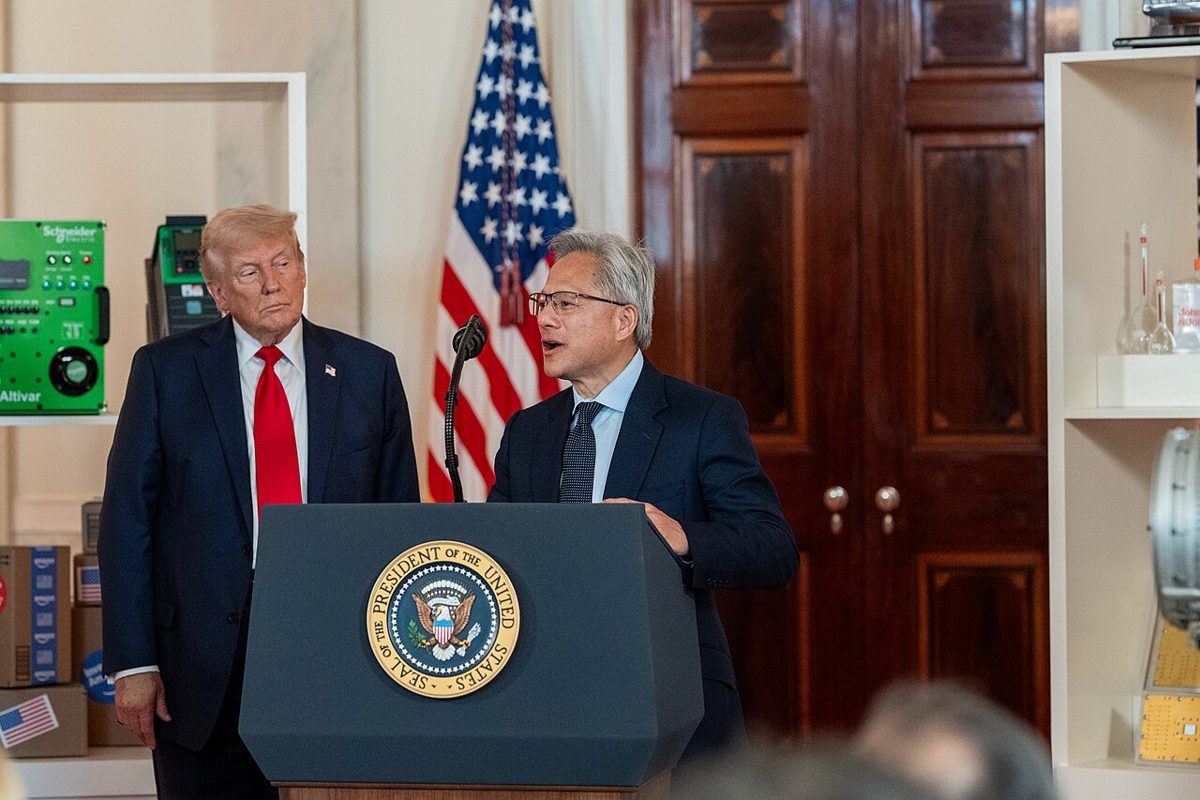
Two of the four science medals went to people whose companies top that list. Huang founded NVIDIA and runs it, and Su is AMD's chair and chief executive. Between them, their companies account for $1.5 billion of the $2.4 billion.
The money doesn't arrive as cash. It's "SI for science tools and compute credits" (SI being the administration's word for AI since Trump renamed it at the UN in September), and it's meant to support more than 15 federal agencies working on what the White House calls National Science and Technology Challenges.
What Anthropic says it will do with its share
Only some of the companies have said how their pledge will be spent. Anthropic posted its plan the same day: $150 million over three years, to put Claude in front of researchers at agencies including NASA, the National Institutes of Health and the National Science Foundation.
Provide Claude, Claude Code, and API credits to several hundred Genesis Mission research projects
The company also says it'll work with the national labs on fusion energy and quantum computing, and help agencies that are new to the mission get their first projects running.
What the medals were for
The citations read like a list of AI's supply chain. Huang's is for turning the graphics chip into a general-purpose computer, which the White House says is now "powering breakthroughs in scientific computing and super intelligence." Nadella's is for the data centers behind it.
for his construction of the hyperscale infrastructure that enabled the training and global deployment of American super intelligence
Musk's citation credits him with work on "space exploration, intelligent systems, communications, and beyond." Michael Kratsios, who runs the White House Office of Science and Technology Policy, called the six winners "the architects of the future."
The White House puts the whole day's announcements at over $6 billion, across government, industry, universities and philanthropy. The same fact sheet lists the $1.8 billion virtual biology initiative that NIH, the Department of Energy and Biohub launched earlier in the week, which we covered on October 7. NASA's nuclear-powered Mars spacecraft, Space Reactor-1, is on the same fact sheet with a 2028 launch.
More on AI policy
- Anthropic is hiring a lead to brief 2028 presidential candidates in both parties on AIOctober 9, 2026
- Trump says the White House treats anyone who says Artificial Intelligence as the enemyOctober 9, 2026
- Fed officials said the AI buildout was adding to inflation when they raised rates in SeptemberOctober 8, 2026
- OpenAI and Meta are among 13 applicants for .agent, ICANN's new domain list showsOctober 8, 2026