Wang and Christie say four fly neurons learn by rewiring, but they haven't published the work
Peter Wang says four cell types in a fly's fan-shaped body learn by changing synapses, and the researchers who watched those cells in live flies saw persistent firing instead.
A connectome is a wiring diagram: every neuron in a nervous system, and every connection between them. The largest one yet was published in Cell on September 3, 2026, covering an adult male fruit fly. Eleven days later a post about four of its cell types started going around.
Peter Wang wrote that he and Nico Christie had run the connectome and found neurons that could let the fly navigate by changing the strength of its synapses as it moves, and that today's language models don't work this way.
I and @nicochristie ran the fly connectome and found the group of neurons (hΔH, hΔA, hΔI and hΔG) that could allow the fly to navigate using fast synaptic weight updates, not neural activations. This is fast-weight continual learning in a fly, something current LLMs don't do!
That claim is doing a lot of work, so I spent an afternoon on what's actually been published about those four cell types. The connectome is real. So are the cells. The mechanism in the post, as far as I know, hasn't been published by anyone. (X wouldn't serve me the post through any normal route, so the timestamp on that card comes from decoding the post's own ID.)
Who posted it
My first assumption was wrong, so I'll correct it here. Reading the name, I thought of Peter Wang the Anaconda co-founder. Wrong one. That Peter Wang posts from @pwang and has nothing to do with any of this. (I suspect I won't be the last to mix the two of them up.)
The Peter Wang behind @BrainsAndTennis is a founding scientist at Fundamental Research Labs, the agent company formerly called Altera. Nico Christie co-founded the same company and had posted his own fly experiment four days earlier. According to 404 Media, people have spent the past two weeks running the fly brain to play Doom and trade bitcoin.
What was actually published on September 3
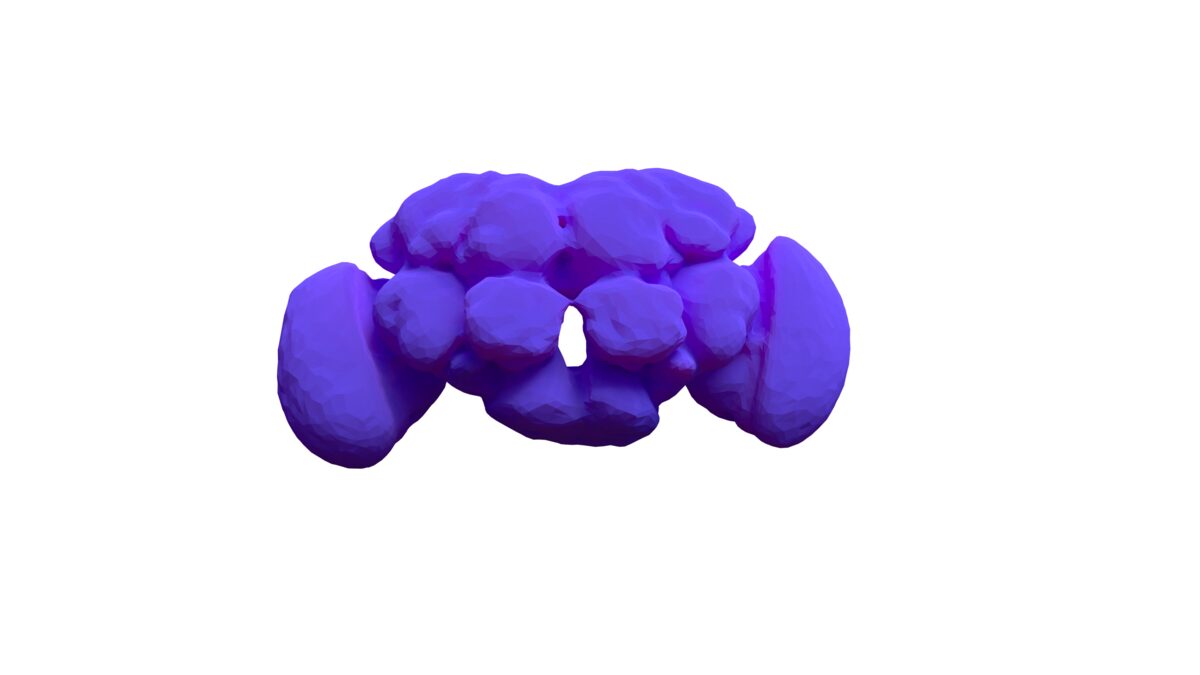
The dataset is called MaleCNS, and it came out of HHMI's Janelia Research Campus and Google Research, with the Cambridge Drosophila Connectomics Group at the MRC LMB. The consortium gives the size like this: "With over 166,000 neurons and 125 million synaptic connections, this is the largest brain map by number of neurons to date." (The same team counted synapses a different way in the preprint, and those figures don't line up with the 125 million.)
The FlyWire map in Nature, October 2024, was an adult female's brain, 139,255 neurons, and it stopped at the neck (a female fly, which matters rather a lot for a paper whose headline finding is sexual dimorphism). This one carries on down the ventral nerve cord, the fly's equivalent of a spinal cord, so it covers the whole CNS.
What the hΔ cells are known to do
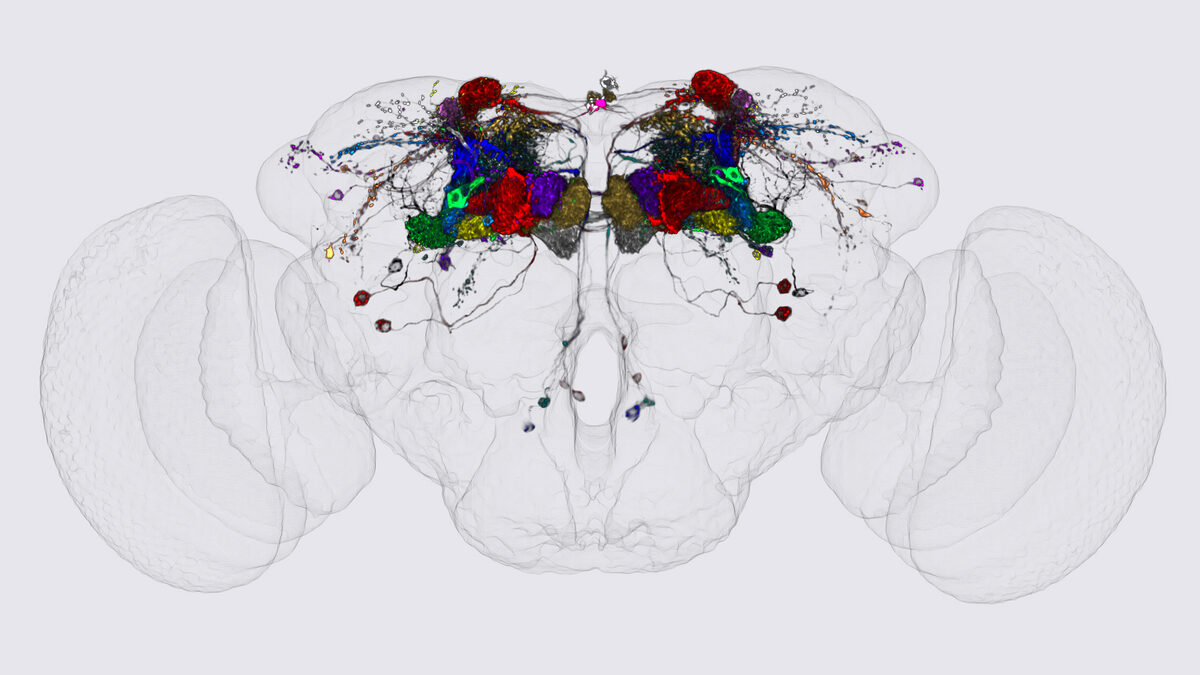
hΔ cells, said "h-delta", are columnar interneurons inside the fan-shaped body, the biggest piece of the fly's navigation hub. Each takes its input in one column and sends its output halfway around the structure, so as a population they behave like a ring that can hold a direction and shift it. The lettered names, hΔA through hΔM, come from Hulse and colleagues mapping the central complex in 2021, and they're anatomical labels, nothing more.
Two of the family have been studied in live flies. hΔB carries a signal for the direction a fly is actually traveling, which Lyu, Abbott and Maimon showed in Nature in 2022. hΔK appeared in an October 2025 preprint from Lanz and colleagues as part of a recurrent loop that holds on to a goal direction.
Lanz and colleagues, as it turns out, describe the opposite mechanism from the one in Wang's post. The goal memory they found is persistent activity, neurons keeping each other firing in a loop that gets switched on when inhibition lifts. The synapses aren't doing the remembering.
hΔH, hΔA, hΔI and hΔG, the four named in the post, appear in the literature as names on a map. I couldn't find a paper or a preprint, refereed or otherwise, claiming that any of them update synaptic weights during navigation. Four searches, including ones aimed straight at bioRxiv. Still nothing.
A wiring diagram can't show a weight changing
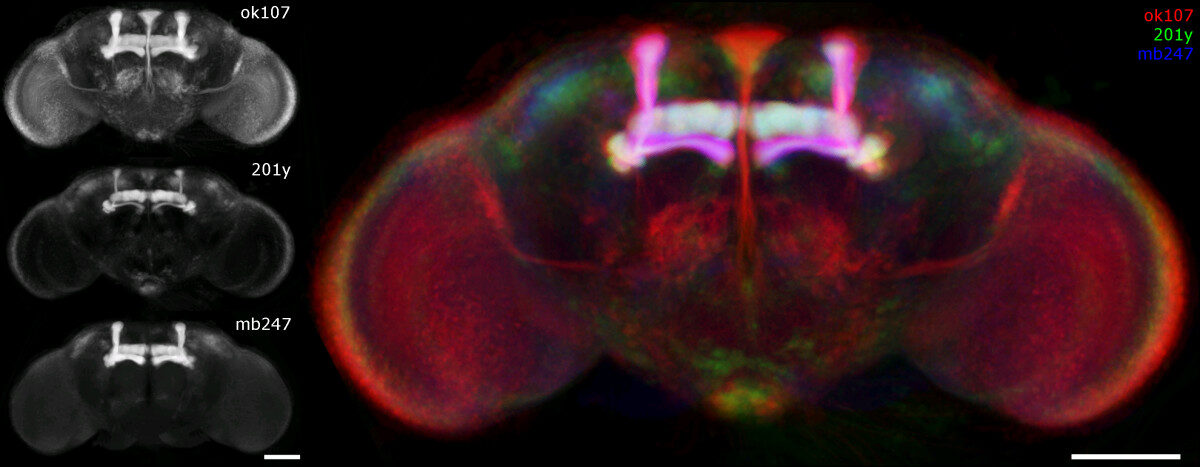
A connectome is anatomy, reconstructed from electron microscope images of a dead animal (the tissue has to be dead and sliced, which is both the point and the limit of it). It tells you which neuron touches which, and roughly how large the contact is. It's a photograph of the wiring at one instant, and a photograph of a wire won't tell you what current ran through it.
Whether a synapse strengthens over a few seconds while an animal walks toward something is a question about a living brain, answered by recording or imaging one. A simulation on connectome data can show fast weights would work in that circuit. Finding that the fly does it is a different result.
So the careful version is narrower and, I think, still worth something: the wiring is compatible with fast weights, an idea Schmidhuber proposed in 1992. To be fair to the post, a deployed model's weights really do sit still while you talk to it. But it's shakier about architectures, because Schlag, Irie and Schmidhuber showed in 2021 that linear transformers are formally fast-weight programmers.
What would settle it
Someone imaging hΔ cells in a walking fly while it learns a new heading, watching whether the connection strengths move. The tools exist and so do the labs. The data is public at male-cns.janelia.org, which is why a scientist at a startup could run it on a Monday.
What a working fly brain would be worth
The fly is the first animal complicated enough to be interesting whose whole nervous system we can both map and run. 166,000 neurons is a size you can simulate end to end, which is why the video-game demos exist at all.
So suppose the plasticity is real. You'd have a complete, inspectable design for something that keeps learning while it runs, at a size you can copy. That's a different source of architecture ideas than scaling one we invented: evolution debugged this one already, and the part worth taking is the part deployed models skip, which is carrying on learning after training ends.
Granted, the scale of it. The hΔ cells number in the hundreds, doing heading rather than thinking, and nobody has shown the plasticity yet. But if that door opens, the fly is where we can see the whole room behind it.