Anthropic's Jack Clark moves his forecast for full recursive self-improvement up to 2027
A new benchmark says AI research taste doubles every three months, and Anthropic's Opus 5.5 tops it.
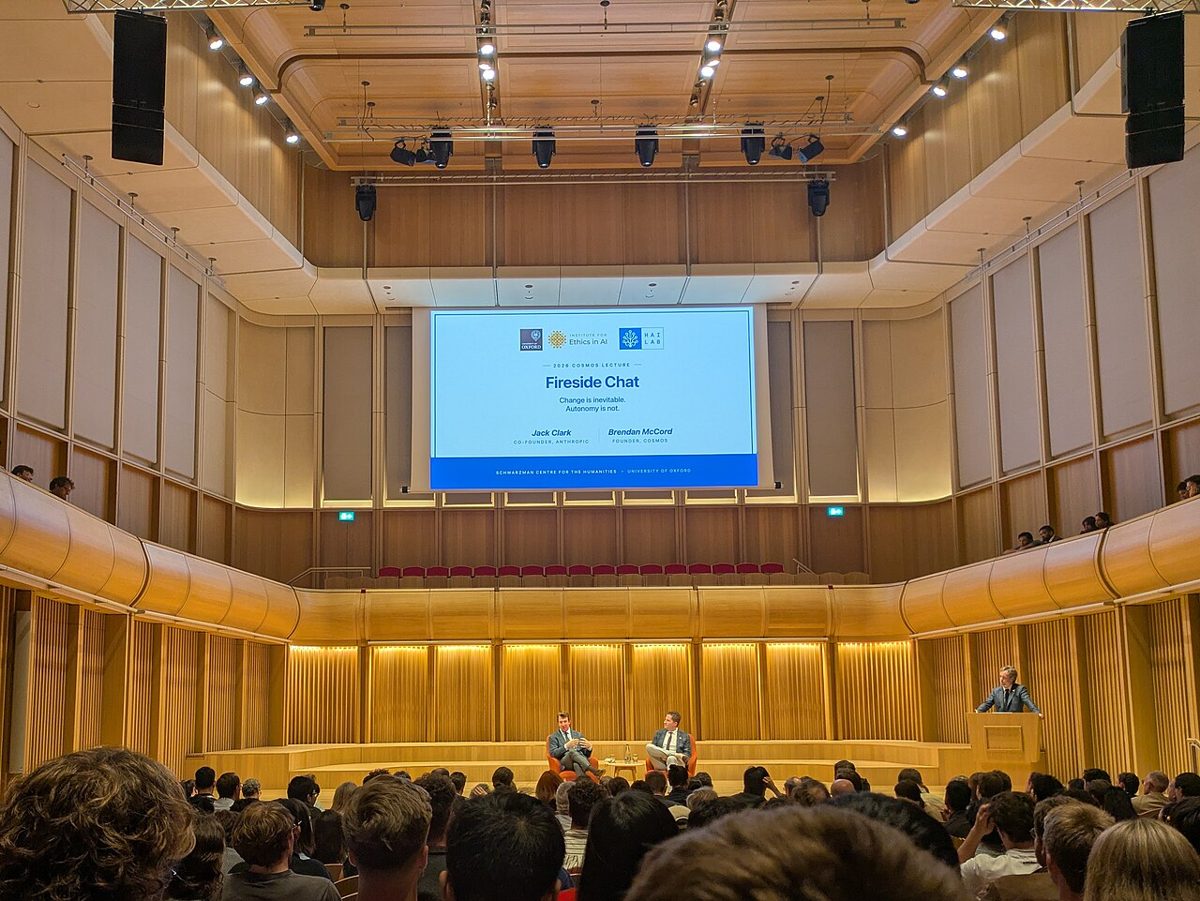
On October 12, 2026, Jack Clark brought forward his own forecast for when AI could fully improve itself. In issue 476 of Import AI, his newsletter, he wrote that full RSI now looks more likely to become possible in 2027. Until now he'd said 2028.
Clark is a co-founder of Anthropic. The change rests on one new benchmark and on what he's seen AI do in math this year.
I now think it’s more likely we’ll see full RSI become possible in 2027, whereas before I thought it was more likely in 2028.
Where 2028 came from
Clark set out his first estimate on May 4, 2026, in Import AI 455. He put a ~60% chance on automated AI R&D by the end of 2028, meaning a frontier model that can train a successor version of itself on its own.
He gave 2027 only 30%, and his reason was creativity. AI research needs "creativity and heterodox insights" to move forward, he wrote then, and AI systems hadn't shown that "in a transformative and major way" yet.
What changed his mind
The new evidence is TasteVal, a benchmark from P-Zero Research that tries to measure research taste. It gives a model 8 tasks from frontier AI work, such as pretraining data curation and preference modeling, and checks how well it designs experiments and draws conclusions. The yardstick is 24 human experts who've recently worked at labs including OpenAI and Google DeepMind.
- Benchmark
- TasteVal, from P-Zero Research
- Tasks
- 8 representative of frontier AI development
- Human baseline
- 24 experts
- Research taste doubling
- every 3.0 months since December 2025
- Best model
- Opus 5.5, compute multiplier of 2.30x
By P-Zero's numbers, frontier models' research taste has doubled every 3.0 months since December 2025. The top scorer was Opus 5.5, Anthropic's own model (our Opus 5.5 brief has its launch), which beat the human baseline at roughly 1/30 of the experts' cost per attempt.
Clark also cites a tremendous advance in AI making creative-seeming math breakthroughs since he wrote the May essay. He doesn't name one in this issue. OpenAI's math papers from an unreleased model, which we covered earlier this month, are one public example.
What he did and didn't change
His new line is about when full RSI becomes possible. He doesn't give a new percentage for 2027, and the issue doesn't say whether 60% for 2028 still stands.
The worries in the May essay haven't moved either. Alignment methods that work today "may break under recursive self-improvement," he wrote, once AI systems get much smarter than the people or systems supervising them.
I'd read the new date with his own caveat from that essay in mind. Every benchmark has quirks, he wrote, and the aggregate trend is what he watches. TasteVal is one benchmark, and a new one.
Clark leads the Anthropic Institute, a think tank studying AI that Anthropic launched in March 2026.
More on Anthropic
- Anthropic moved its monorepo off git after daily merges rose from 2,500 to 30,000October 13, 2026
- Anthropic researchers say small AI models may be months from spreading across Android TV boxesOctober 13, 2026
- Anthropic says new defenses cut the data distillers take from Claude by 90 to 99%October 13, 2026
- Musk says Anthropic's ban on cruelty to Claude is the right moveOctober 11, 2026