DeepMind researchers call AI's climb past human level to superintelligence within a decade a serious possibility
The authors add that slowing AI by limiting compute alone won't stop it, and could make the jump sharper later.
The DeepMind Institute, a publishing platform started by researchers from Google and Google DeepMind, has put up an essay called What Comes After AGI? It says AI could keep advancing at its current pace past human level, toward what it calls artificial general superintelligence, or ASI.
The essay condenses From AGI to ASI, a technical report by Tim Genewein and 13 other authors, Shane Legg among them. The essay's conclusion is hedged, but it puts a time frame on the idea.
continued fast AI progress over the next decade is a serious possibility.
- Published by
- DeepMind Institute, started by researchers from Google and Google DeepMind
- Based on
- From AGI to ASI, by Tim Genewein and 13 other authors
- Effective compute growth
- at least 10x per year
- Cost in ten years
- $1000 for a workload costing $1 billion today
What the authors mean by superintelligence
The bar is high. ASI, in the essay's definition, consistently beats large groups of human experts on work that would take them years, using less time and fewer resources. Its examples are a whole research field's progress in a fraction of the time, or a year of a large company's chip design work.
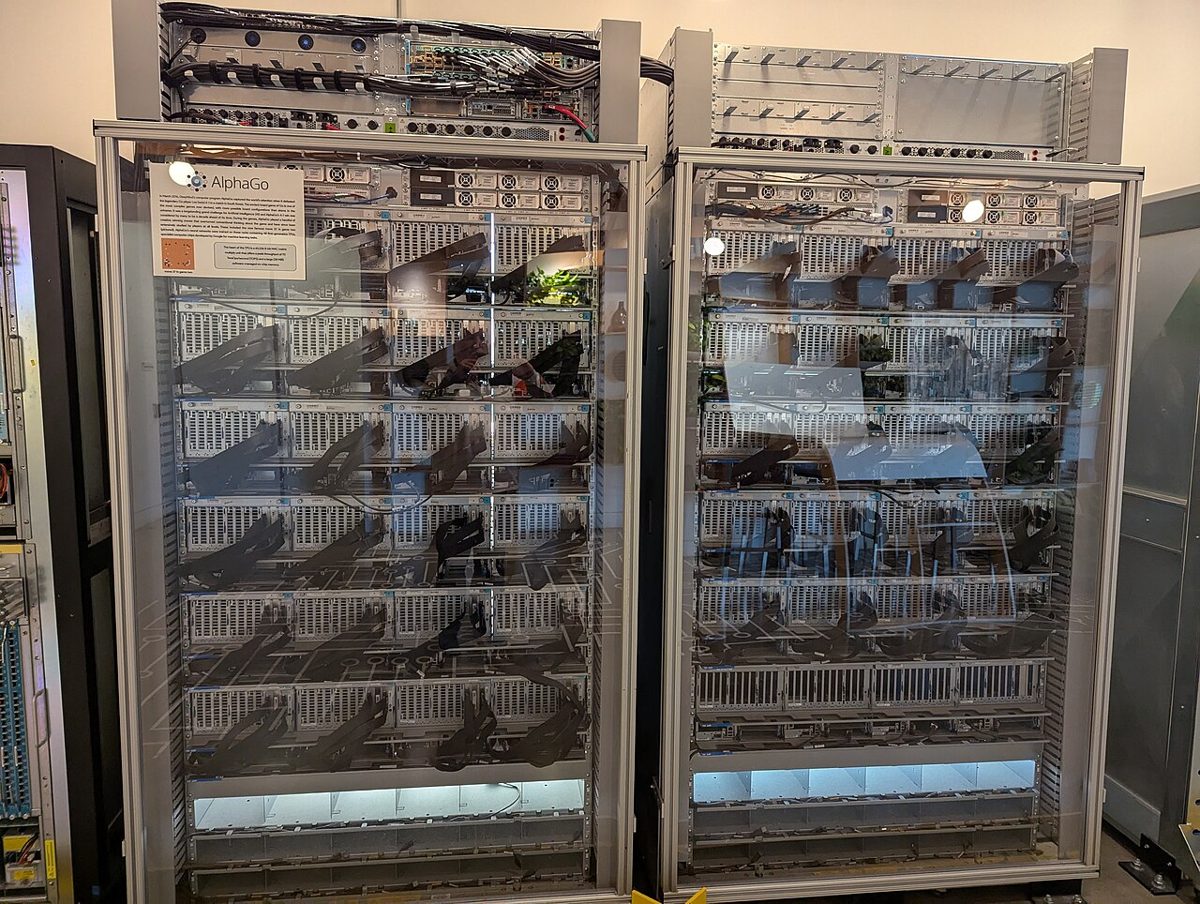
It has to clear that bar across nearly every task people care about. Narrow superhuman systems already exist, and the essay names chess, Go and protein structure as examples that don't count.
The cheap-AI argument
The first section doesn't need the frontier to move at all. The authors multiply the trends in chip prices and algorithm efficiency by the growth in hardware spending, and get effective compute growing at least 10x a year, a factor of 10 billion over a decade.
Efficiency alone, they write, cuts the cost of running a given AI workload about 4x a year.
A cognitive workload that can be performed by today’s AI systems for $1 billion in compute tokens would cost just $1000 in ten years.
They call the result cognitive industrialization. Scale only today's models up in speed and number, they concede, and you might not even get full AGI. Billions of fast agents, though, might be enough to reach a weak form of ASI on their own.
Four ways past human level
For the abilities that sheer numbers can't buy, the essay lists four routes. One is scaling models and data further. Another is a paradigm shift beyond today's transformers. A third is coordinating thousands or millions of AI agents into groups, and the last is recursive self-improvement.
Each comes with its own brakes. High-quality training data is being used up faster than people produce it. Bigger compute runs need power plants and chip fabs, which take years to build. Agent swarms hit diminishing returns as they grow. Self-improvement loops can stall when the feedback guiding them is poor, so the authors expect it to move fastest where a machine can check the answer, like mathematical proofs.
What it means for jobs and for AI rules
The jobs claim is the one most readers will feel first. The essay says that even without dramatic progress at the frontier, cognitive industrialization alone could reshape knowledge work and the wider economy. It gives no estimate of how many jobs, or which ones, and no timeline beyond the decade.
The policy claim is sharper, and it cuts against a lot of current thinking about slowing AI down.
trying to slow down AI development by restricting just one area - like the computing power for training an AI model - won't be enough to stop overall progress.
Holding back one input while the others keep moving, the authors write, risks an overhang, with a sudden jump when the restriction lifts. The essay names no policy. The closest ones I can think of are chip export limits, and the compute side of Dario Amodei's call to pace the frontier.
What they ask for instead is plainer: model, measure, forecast, repeat. They say tracking the four pathways will need frontier-model access and large amounts of evaluation compute, shared between labs and national and global institutions. My reading is that this is a request for outside measurement more than a forecast.
The essay carries a disclaimer that it reflects the author's ideas and should not be read as Google's official view. The underlying report on arXiv was last revised on November 10, 2026.
More on Google
- Google tests Chrome's AI agent on a synthetic web, hidden so models can't tellNovember 19, 2026
- Google finds attackers using an AI tool that turns security patches into exploits, no human involvedNovember 16, 2026
- Demis Hassabis says an AI 'oil spill' will happen unless labs pay far more attentionNovember 16, 2026
- Google puts Gemini 4 Hydrogen in Search for everyone, and says it edges past ArgonNovember 12, 2026