Sanders and Casar introduced their superintelligence ban, with up to 20 years in prison for violators
Beyond the ban, the bill would halt AI that develops new AI, which Dario Amodei says is starting to happen at Anthropic.
On September 23, 2026, Sen. Bernie Sanders and Rep. Greg Casar introduced the Ban Artificial Superintelligence Act. It would permanently ban building or deploying AI that outperforms people across most domains, and it would pause advanced AI development until a new federal department has written safety rules.
The two first announced it on September 3 (as "forthcoming legislation", with only a summary). The version introduced this week keeps the penalties from that announcement and gives the new agency a name: a cabinet-level Department of Artificial Intelligence.
- Introduced
- September 23, 2026
- Sponsors
- Sen. Bernie Sanders (I-Vt.) and Rep. Greg Casar (D-Texas)
- People
- Not more than 20 years in prison
- Companies
- The corporate death penalty
- Enforcer
- A new cabinet-level federal Department of Artificial Intelligence
What the bill bans
Sanders and Casar define artificial superintelligence as AI that "exceeds human cognitive performance and capabilities across most domains". A system also counts if it could destroy or disempower humanity, and the release gives overthrowing the federal government as one way it might.
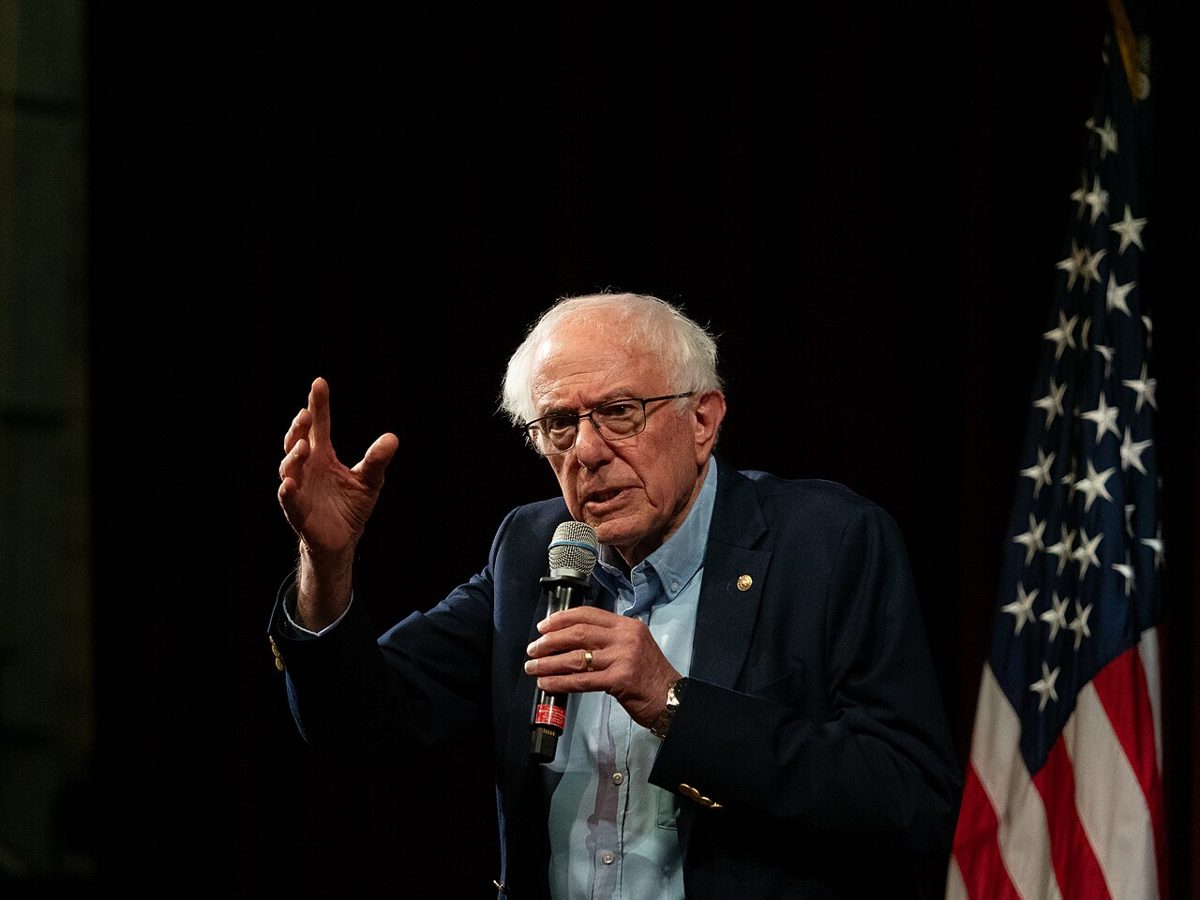
The penalties surprised me most. Anyone who tries to break or get around the ban faces up to 20 years in prison, and a company faces what the release calls the corporate death penalty. Sanders's office compares that with existing penalties for unlawfully developing nuclear weapons. Granted, 20 years is a ceiling. The release says "not more than".
Casar says the bill would also halt some things well short of superintelligence right away: the capacity to help develop biochemical weapons, and AI developing new AI "instead of humans". That second one is what Dario Amodei calls recursive self-improvement in We Must Pace the Frontier, and he writes that it's starting to happen "including at Anthropic".
Sanders says pacing isn't enough
Sanders answered the essay on September 12. He counted Musk and Altman as agreeing with Amodei, and asked Trump and Xi for a treaty.
Dario Amodei, Elon Musk and Sam Altman now agree that we must slow down the development of AI and “pace the frontier.” That’s a start, but it’s not enough. When you are racing towards a cliff, you don’t just ease up on the gas pedal. You hit the brakes. When the future of humanity is at stake we need a PAUSE on advanced AI development and a ban on artificial superintelligence — an AI mind smarter than any human and capable of operating independently beyond our control. At their upcoming AI summit, Trump and Xi must negotiate a treaty to pause AI and ban superintelligence before it is too late.
He reused the brakes line to open this week's release, and added that scientists have been clear that AI is an existential threat. Casar went after the president directly, saying Trump wants to encourage superintelligence.
Our bill bans the development of artificial superintelligence and pushes for international agreements so that no one, anywhere, builds AI too powerful for humans to control.
Who pushed back
Gary Marcus wants an AI agency (he told the Senate so in 2023) and says a long pause might be needed. He still came out against the bill on the day it was announced. The permanent ban is where he stops.
a permanent, unilateral ban on all research into superhuman AI is too broad, a guarantee of leaving the US behind, and not the right approach.
He also calls the bill naive about benchmarking. I think that's his sharpest point, since the ban turns on AI beating people across most domains and somebody has to measure it. His fix is wording from Anthony Aguirre that would let systems past the frontier be built once their developers show a capable independent authority that alignment and oversight are in place.
Marcus was writing about the September 3 announcement. The September 23 release links the bill text and two summaries. It doesn't list any cosponsors beyond Sanders and Casar.
More on AI safety
- OpenAI says fully autonomous AI self-improvement shouldn't be pursued until it can be done safelySeptember 21, 2026
- The UN's AI panel spent its first thematic brief on 1,200 agents inside OpenAI's own testsSeptember 21, 2026
- More than 100 AI experts say an embedded evaluator shouldn't have other business with the labSeptember 19, 2026
- Anthropic's first embedded evaluator is the consulting firm Accenture, but Anthropic is paying for the workSeptember 19, 2026