Google sends its AI chips to orbit next week, ahead of its two-satellite test in 2027
The first question is whether the chips survive 10 minutes of launch, and then whether they can shed heat with no air around them.
On September 24, 2026, Google said the first test satellite for Project Suncatcher launches next week. It carries Google's TPUs and flies on SpaceX's Transporter-18 rideshare mission. Google built it in partnership with Planet.
The flight asks one narrow question: can the chips get through a launch and then keep working in orbit? The timing surprised me. When Sundar Pichai announced the project on X in November 2025, the first milestone he named was two prototype satellites with Planet "by early 2027." This launch comes before that, and the pair of satellites is still planned for 2027.
- What
- a prototype satellite to evaluate how Google TPUs perform in space
- Ride
- the Transporter-18 rideshare mission with SpaceX
- Partner
- Planet
- Next
- two satellites in orbit in 2027
Why put AI chips in space?
Sunlight, mostly. In low Earth orbit a satellite can get near-constant sun and up to eight times the solar power it would get on the ground, according to the post by Travis Beals, a senior director at Google.
The long-range plan is clusters of satellites flying close together and talking by laser. Google's research team sketched an 81-satellite cluster in 2025, and its analysis of launch prices had them falling below $200/kg (per kilogram lifted, that is) by the mid-2030s. At that price, the team wrote, running a data center in space could cost roughly what the energy for one on Earth does.
What the test has to prove
Getting there is rough. The ride to low Earth orbit takes about 10 minutes, at up to 10 g, and single parts like the TPU chips can take 50 to 100 g. Google shook the satellite on all three axes to copy a launch, and says it was pleasantly surprised the hardware held up.
Radiation's the other worry, since solar events and cosmic rays can wreck electronics. So the team ran AI workloads on its Trillium TPUs (the same generation Pichai said had survived a particle accelerator back in 2025) in a proton beam at UC Davis's Crocker Nuclear Laboratory, and the chips took a total dose greater than they'd get in a five-year mission.
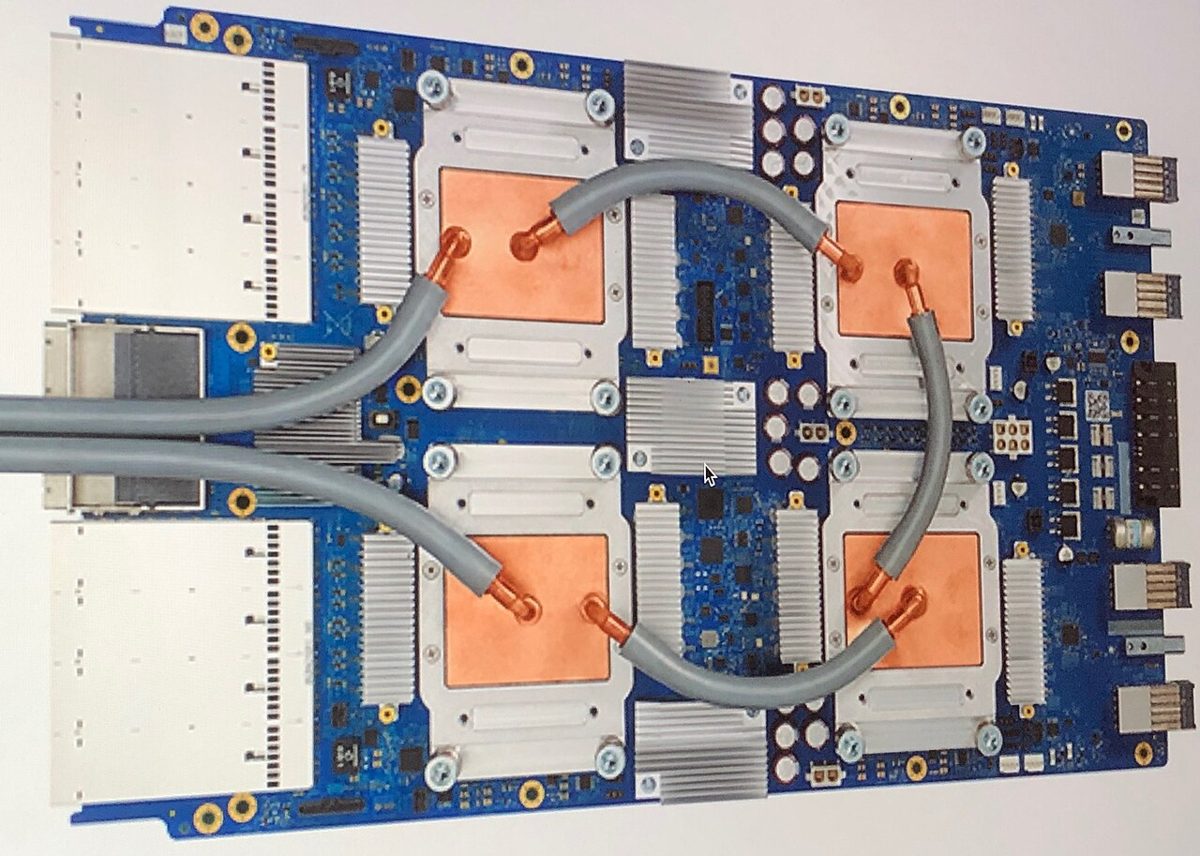
In a vacuum, you can only diffuse heat via radiators, which requires a totally different approach to cooling electronics.
Cooling's the part I'd watch, though. Google's design pairs heat pipes with radiators, and so far it's only been tried in a thermal vacuum chamber on the ground. Next week is its first real run.
The same afternoon
Google keeps calling this a first step. Elon Musk, posting a few hours later without naming Google, went a good deal further.
The amount of compute in space will obviously round up to 100% of all compute
After this flight, the next Suncatcher milestone is the pair of satellites in 2027, which will test the short-range laser links a cluster would need.
More on Google
- UK regulator proposes AI assistants like ChatGPT on Google's choice screens, with a prompt every yearSeptember 23, 2026
- Gemini models explained: 3.8 Flash vs Flash-Lite vs 3.1 Pro, with every release dateSeptember 23, 2026
- “Usage limit reached for all Pro models.” in Gemini CLI: what ran out and what to doSeptember 23, 2026
- “429 RESOURCE_EXHAUSTED” from the Gemini API: which quota you hit and how to tellSeptember 23, 2026