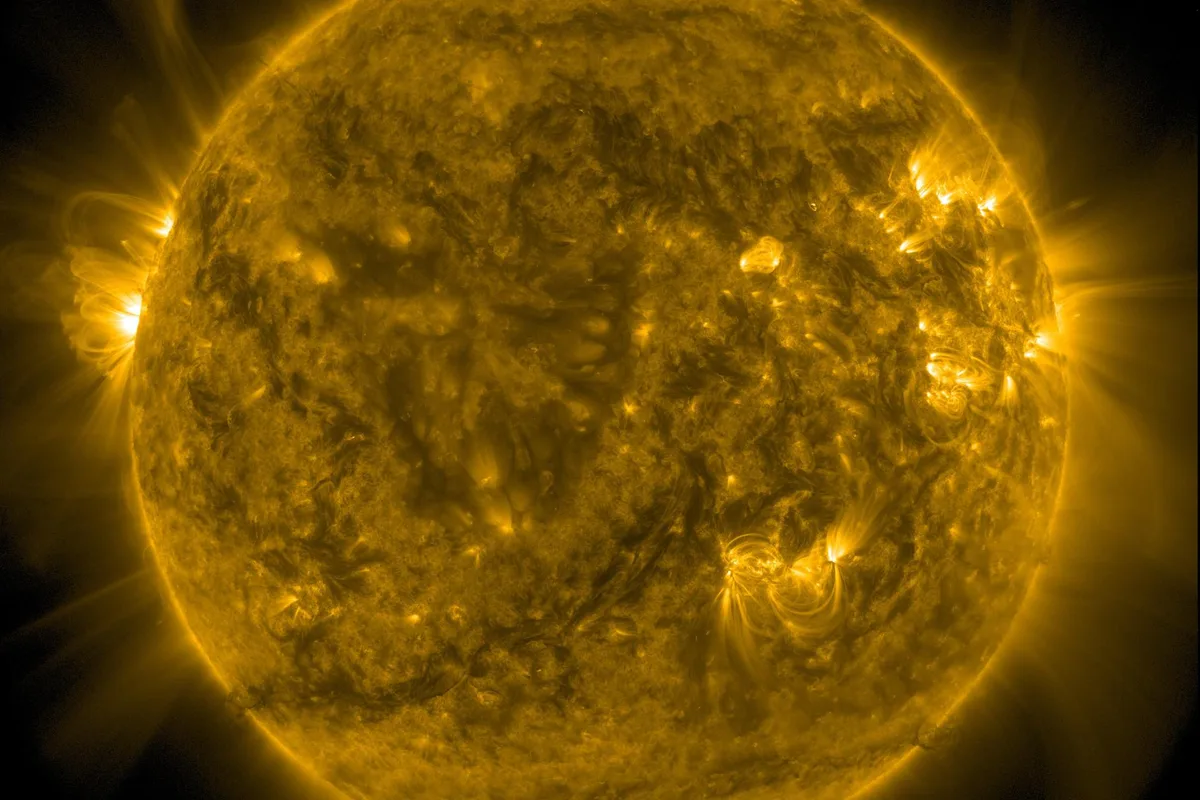
Free, limitless energy has been the dream ever since we worked out what powers the stars. Before getting to the dream, though, it's worth sitting with an unglamorous fact about how electricity actually gets made, because almost nobody thinks about it and it explains why fusion is so hard.
Most power plants are kettles.
Coal, gas, oil, nuclear fission: every one of them is an elaborate machine for boiling water. The water becomes steam, the steam shoves a turbine, the turbine spins a magnet inside a coil of wire, and that's your electricity. Wind and hydro skip the boiling and go straight to the spinning. The only major source that breaks the pattern is solar, where light knocks electrons loose inside a panel and nothing moves at all.
So how much of the world's electricity is still, underneath it all, something spinning? In 2025 solar generated 8.7 percent of it1. Round that off, and roughly nine tenths of the power on Earth still comes from turning a shaft. We've spent a century getting very good at one trick.
Fusion, mostly, is a bid to do that same trick with a better fire.
Fission splits, fusion sticks
Both of the nuclear options work by rearranging the middle of an atom, and they go in opposite directions.
Fission, the kind in every nuclear plant running today, takes a heavy atom like uranium and breaks it in half. Fusion takes two very light atoms and jams them together into one heavier one, which is what the Sun has been doing in its core the entire time you've been alive.
I started this assuming fusion was orders of magnitude more powerful. That's not right, and the way it's wrong turned out to be the interesting part.
Per reaction, fission wins by a lot. Splitting one uranium atom releases roughly ten times what fusing two hydrogen atoms does. Fusion's advantage is that its fuel is so much lighter, so you get more reactions out of the same weight. Measured per kilogram of fuel, the IAEA puts fusion at a bit over four times fission2. Four times is excellent. It isn't infinite, and it isn't a different category of physics.
The real case for fusion was never raw output anyway, which boils down to three main perks:
- The fuel comes from water and lithium instead of mined uranium
- The reaction stops the instant you stop feeding it rather than needing to be actively shut down; and
- The waste is a fraction of fission's, with nothing that stays dangerous for tens of thousands of years.
Why it's so hard
To fuse, two atomic nuclei have to touch. They both carry a positive charge, and like charges shove each other apart, so the only way to make them touch is to throw them together hard enough to overcome that shove.
The Sun manages it with sheer weight. Its gravity squeezes its core so tightly that fusion happens at a relatively modest 15 million degrees Celsius.
We can't build gravity. So we substitute speed, which means heat, which is why every fusion machine on Earth is trying to hit about 100 million degrees, roughly seven times hotter than the middle of the Sun. Nothing solid survives contact with that, so the fuel is held in a magnetic field instead of touching a wall. At those temperatures the fuel isn't a gas any more, it's a plasma, an electrically charged soup that magnets can grip.
That's the whole engineering problem, and it splits into three parts that all have to work at the same time.
The three problems, and who's winning each
One: hold it still. Plasma is unruly. It writhes, and it wants to touch the walls, and when it does the reaction stops. So the first question is simply how long you can keep it in one piece.
China's EAST machine holds the record here. In January 2025 it kept a plasma stable for 1,066 seconds, which is nearly 18 minutes, more than double its own previous best. EAST is a tokamak, the doughnut-shaped design that most fusion reactors use.
Two: get it hot enough. Holding a cool plasma is much easier than holding one at fusion temperature, so duration records and temperature records aren't the same achievement.
Korea's KSTAR is chasing the hard version. The Korea Institute of Fusion Energy confirmed 48 seconds at 100 million degrees in April 20243, up from 30 seconds in 2021, and the team's stated target is 300 seconds by 20264. That's this year, and I couldn't find an announcement saying they've got there.
Forty-eight seconds sounds trivial next to EAST's eighteen minutes. It isn't. They're measuring different things.
Three: get more energy out than you put in. This is the one everybody means by "fusion works," and it's the one with the most misleading headlines.
The National Ignition Facility in California takes the other approach entirely. Instead of holding plasma in magnets for minutes, it fires 192 lasers at a fuel pellet the size of a peppercorn, crushing it so fast that it fuses in a few billionths of a second. In December 2022 one of those shots released more energy than the lasers delivered to the pellet, the first time any machine had done that. It's now happened eleven times.
- Dec 20223.15 MJ
- Jul 20233.88 MJ
- Oct 2023 (1st)2.4 MJ
- Oct 2023 (2nd)3.4 MJ
- Feb 20245.2 MJ
- Nov 20244.1 MJ
- Feb 20255 MJ
- Apr 20258.6 MJ
- Jun 20252.4 MJ
- Oct 20253.5 MJ
- Jun 20267.9 MJ
A megajoule is about what it takes to boil three liters of water. The record shot, 8.6 MJ, would boil roughly 25 liters, which is a full kettle nine or ten times over.
Show the numbers
| Item | Value | Note |
|---|---|---|
| Dec 2022 | 3.15 MJ | The first time out beat in |
| Jul 2023 | 3.88 MJ | |
| Oct 2023 (1st) | 2.4 MJ | |
| Oct 2023 (2nd) | 3.4 MJ | |
| Feb 2024 | 5.2 MJ | |
| Nov 2024 | 4.1 MJ | |
| Feb 2025 | 5 MJ | |
| Apr 2025 | 8.6 MJ | The record. 2.08 MJ went in, 8.6 MJ came out |
| Jun 2025 | 2.4 MJ | |
| Oct 2025 | 3.5 MJ | |
| Jun 2026 | 7.9 MJ |
Two things to take from that5. The first is that progress is lumpy. A shot in June 2025 released less than the very first success two and a half years earlier. This isn't a machine being tuned steadily upward, it's a machine being wrestled with.
The second is the asterisk, and it's a big one. That "more out than in" is measured against the energy the lasers put onto the pellet, not the energy the building pulled from the wall to charge those lasers, which is something like a hundred times larger. By the honest measure, the one that matters for a power plant, NIF has never come close. It's a weapons-physics lab that proved the reaction can be made to pay for itself. It was never trying to be a power station.
Who's actually building one
ITER is the big international bet: 35 countries, one enormous tokamak going up in southern France. It slipped in 2024. Running it at full strength is now scheduled for 2036, and the fuel mix an actual power plant would use is 2039, delays of three and four years6. The reasoning is defensible. Rather than rush to a symbolic first flicker of plasma, they decided to install the hard parts first, including the divertor, and start with experiments that teach them something. It's an honest schedule. It's also a long time to wait.
Commonwealth Fusion Systems is building a much smaller tokamak called SPARC outside Boston, betting that a newer kind of superconducting magnet lets you shrink the whole machine. As of mid-2026 it's about 80 percent assembled, first plasma has slipped from 2026 to 2027, and it raised a billion dollars from pension funds in July 2026.
Helion Energy is the one that breaks my kettle framing, which is why it's the most interesting thing here. In January 2026 its Polaris machine became the first privately built device to run on the real fusion fuel mix, and it hit 150 million degrees7. More to the point, Helion isn't planning to boil anything. Its plasma expands and pushes back against the magnetic field that squeezed it, and a moving magnetic field induces electric current directly in a coil. No steam, no turbine, no shaft. Nobody has shown that works at useful scale. It is the first serious attempt to skip the kettle altogether, and Helion is building a bigger machine, Orion, to sell power to Microsoft from 2028.
TAE Technologies has been at this for nearly three decades on a design where the plasma helps confine itself. Persistence is its own kind of achievement.
So how close is it
Closer than it was, and further than the headlines suggest.
Every number up there is real, and not one of them is a power plant. Nobody has built a machine that makes more electricity than the whole building consumes, run it for a useful stretch, and then done it again the next day. Holding it still, getting it hot, and getting more out than in are three legs of the same stool, and no one has all three yet, never mind the parts nobody puts in press releases: handling radioactive fuel, and finding wall materials that survive years of being blasted by neutrons.
The old joke is that fusion is thirty years away and always will be. The joke is getting weaker. Fusion isn't waiting on physics any more, it's waiting on engineering, and engineering problems tend to yield to money and time in a way that physics problems don't.
One thing's worth keeping in view, though. While fusion has been getting closer, solar went from 3.8 percent of the world's electricity in 2021 to 8.7 percent in 20251, with no moving parts and no plasma at all. The dream was always to harness the power of the Sun. There's a decent chance we end up doing it the lazy way, at a distance of 93 million miles, and leaving the reactor where it is.
Comments
Log in to leave a comment.
No comments yet.